- Instructor: Stephen nan Mishita
University of Dar Es Salaam Computing Centre Learning Management System
-
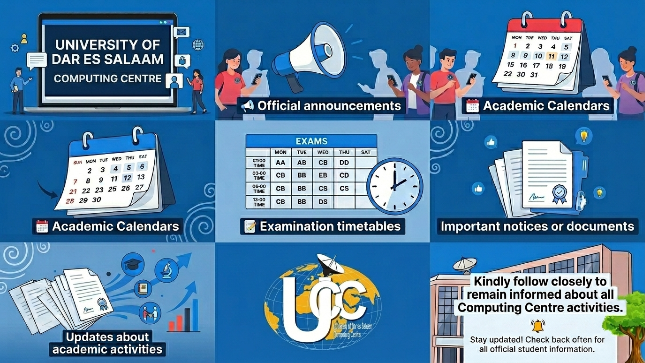
OFFICIAL INFORMATION HUB
-
NOTICE TO ALL CERTIFICATE AND DIPLOMA STUDENTS (DAR ES SALAAM AND DODOMA BRANCHES)
RE: END OF SEMESTER EXAMINATION TIMETABLE (CIT AND BUSINESS PROGRAMMES)
This is to inform all students enrolled in Certificate and Diploma programmes in Computing and Information Technology (CIT) and Business at both the Dar es Salaam and Dodoma branches that the End of Semester Examinations Timetable has been officially released by the Examination Office, University of Dar es Salaam Computing Centre (UCC).
The examinations will be conducted from Monday, 24 August 2026 to Friday, 28 August 2026.
All students are advised to:
- Obtain and carefully review the examination timetable.
- Begin preparing adequately for their examinations.
- Ensure they attend all examinations according to the scheduled dates and times.
- Read and familiarize themselves with the UCC Examination Rules and Regulations and strictly adhere to them throughout the examination period. Any student found violating the examination rules or engaging in any form of examination misconduct will be discontinued from studies in accordance with UCC Examination Regulations.
The examination venue(s) will be communicated in due course.
We encourage all students to prepare thoroughly and wish you every success in your End of Semester Examinations.
Examination Office
University of Dar es Salaam Computing Centre (UCC) -
📄 Field Practical Training (FPT) documents are now available for download.
302.0 KB -
PROSPECTUS File PDF
The Student Prospectus is ready for download.
📖 All students are encouraged to download, read, and understand its contents, as it contains important academic regulations, policies, and guidelines.
-
-
📅 The Academic Calendar is now available for download. All students are advised to download and review it carefully to stay informed about important academic dates and activities.
-
SPECIAL ANNOUNCEMENT FOR ONLINE REGISTERED STUDENTS
The timetable is now available and can be downloaded here.
· All online registered students are reminded to maintain regular communication with their instructors.
· Please ensure that you call or email the instructors of your respective modules for updates, guidance, and any academic inquiries.
Thank you.
Administration
-
Site announcements
There are no discussion topics yet in this forum.
Skip available courses
Available courses

- Instructor: Louis Kachira Mulengera
- Instructor: Leo nan Renatus
- Instructor: Admin User

- Instructor: Zainab nan Abdillah
- Instructor: Augustino nan Mlinga
The course introduces students to the concepts and techniques for the art of writing computer programs. It will teach students the simple and practical approach of creating computer programs while learning computer programming.
- Instructor: Florence Andwile Masebo
This course provides students with the knowledge and skills required to develop object-oriented applications using Java. Topics covered include Java programming fundamentals, class design, object creation, constructors, methods, inheritance, polymorphism, abstraction, interfaces, exception handling, file handling, and Java Collections Framework. Through hands-on exercises and practical projects, students will learn how to build reliable, maintainable, and scalable software solutions.
Learning Outcomes
Upon successful completion of this course, students will be able to:
- Explain the fundamental concepts of Object-Oriented Programming.
- Design and implement classes and objects in Java.
- Apply encapsulation, inheritance, polymorphism, and abstraction in software development.
- Handle exceptions and errors effectively in Java applications.
- Develop and test object-oriented Java programs.
- Apply best practices in Java programming and software design.
Course Content
- Introduction to Java Programming
- Classes and Objects
- Constructors and Methods
- Access Modifiers
- Encapsulation
- Inheritance
- Polymorphism
- Abstraction
- Interfaces and Abstract Classes
Course Requirements
Students are expected to:
-
-
- Attend all scheduled lectures and practical sessions.
- Complete assigned coursework and programming exercises.
- Participate in discussions and collaborative learning activities.
- Submit assignments before the specified deadlines.
-
Assessment Methods
-
-
- Assignments and Practical Exercises
- Quizzes and Tests
- Class Participation
- Final Examination and/or Project
-
Course Manual
Getting Started
-
-
- Review all course materials available on Moodle.
- Download lecture notes and supporting resources.
- Complete weekly learning activities and assignments.
- Participate actively in discussions and practical sessions.
-
Academic Integrity
Students must adhere to academic integrity standards. Plagiarism, cheating, or unauthorized collaboration will not be tolerated and may result in disciplinary action.
Support and Communication
For academic or technical assistance, students should contact the course instructor through Moodle or other official communication channels provided by the institution.
- Instructor: Ahmed Hassan Abdulrahman
- Instructor: Zainab nan Abdillah
- Instructor: Beatrice Faustine Licky

- Instructor: Peter Moses Kabigi
- Instructor: Macdonald Nehemia Machange
- Instructor: Makasi Kasim Killama
- Instructor: Admin User
Skip course categories